
Challenges for Future AI Systems
Exploring new frontiers of mathematical research
The ongoing rapid development of AI tools is also accelerating mathematical research and opening up new territories of knowledge! Nevertheless, there are new frontiers and limits that continue to challenge AI systems and human researchers. Surely, AI helps us to solve problems that have long resisted human efforts. However, other problems will remain open for centuries and even much longer. Drawing on more than twenty years of experience with computer-assisted proofs and human-readable certificates, we enjoy exploring new mathematical frontiers with current and future AI tools. One important focus is on making knowledge accessible and enjoyable for future mathematicians. Using these powerful new "weapons of math instruction" responsibly serves both mathematics and humanity — assuming the goal is to survive another century, millennium or even longer!
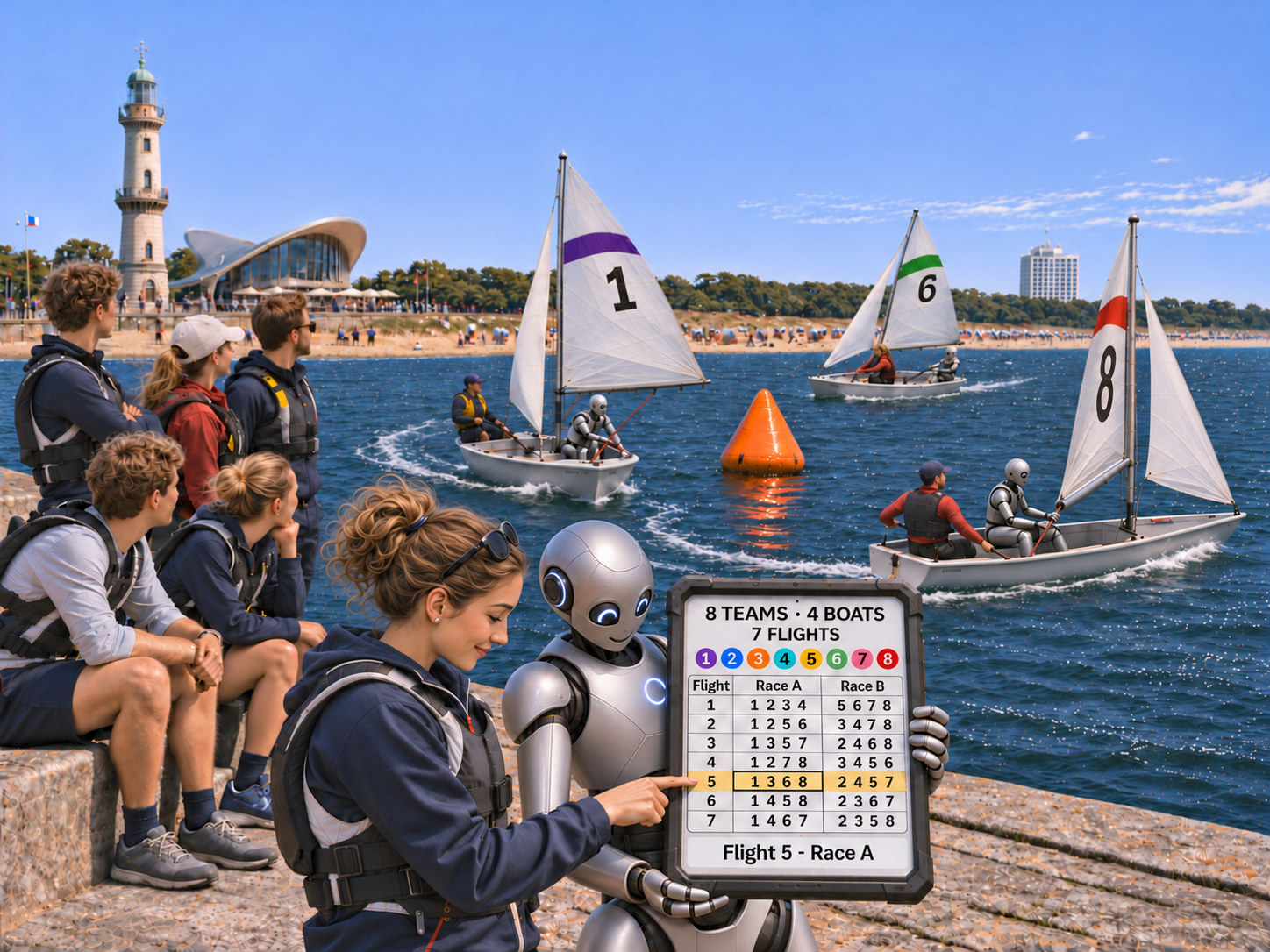
Among our favorite benchmark problems are currently Sailing League Problems, the Lonely Runner Conjecture and the classification of Universally Optimal Point Configurations. As we increase the number of teams, runners or dimensions, new mathematical challenges emerge. Every dimension is a new game!


Recent progress
In October 2026, an AI-assisted proof was reported for up to 16 runners. The claim awaits independent verification by human mathematicians. Also in October 2026, OpenAI announced a proof of universal optimality of the 2-dimensional hexagonal lattice. This also has to be confirmed by independent human referees.
What is next?
We don't know. Could we solve cases involving, say, up to 42 teams or 42 runners within this century?! The quest for universally optimal point configurations seems to be fundamentally more difficult. Our familiar Euclidean 3-space has a fascinating phase transition phenomenon, but no universally optimal point configuration exists. In dimension 4 there exists a highly symmetric candidate — the checkerboard lattice — whose universal optimality will likely remain open for some time. The putative next big challenge — dimension 9 with the first non-lattice candidate — could possibly stay open for the rest of this century? In dimensions 42 and beyond, even identifying a plausible candidate may stay difficult. Do universal optima exist there at all?